Andrew Johnson* knows all about the now-25-year-old Americans With Disabilities Act, the historic civil rights legislation that, as President Obama said in his famous 22nd anniversary address, “affirmed Americans with disabilities are Americans first.”
Obama said that when many “wrongfully doubted that people with disabilities could participate in our society, contribute to our economy, or support their families, the ADA asserted that they could.… America became the first nation to comprehensively declare equality for its citizens with disabilities — an accomplishment that continues to guide our country toward fulfilling its most essential promises not just for some, but for all.”
Andrew knows the ADA is supposed to protect HIV-positive workers like himself, who can’t legally be denied jobs or be fired for having HIV or for requesting reasonable accommodations needed to do their jobs and stay healthy. Andrew thought the ADA would protect him when approaching his human resources rep and asking for those “reasonable accommodations,” he recalls. “They then asked for it in writing along with a supporting letter from my doctor. Once they had proof of my status, I was terminated.”
He went to an employment lawyer after he was canned; the attorney told him “that my workplace knew that they were breaking the law, but that it would be easy to break the law and settle with me afterwards. I wish I could tell you that I was working for a conservative organization in a small town, but that is not the case — quite the opposite.”
For Andrew, the takeaway was that he’ll never feel safe disclosing in another workplace. “Sadly, it is still quite dangerous,” he says, for poz workers to come out. Andrew is right. In some places, at some companies, coming out about being positive can be a one-way ticket to the unemployment line — even though that’s a violation of federal law.
Many companies are woefully ignorant about the ADA’s protections; others find ways to fight claims by saying the accommodations requested weren’t reasonable. Still, there’s good news: Today many companies are learning to embrace their poz workers, to incorporate people living with HIV not just into their workplace but into the culture of their companies. Living with HIV is a lot like living — and working and loving and having a family—with any other disability or chronic illness, and some companies are taking extra strides to support people living with HIV.
In 2012, for example, Microsoft’s Texas Diversity Leadership Team donated money and staffing, and hosted the opening and closing ceremonies, for the Lone Star Ride Fighting AIDS, an annual cycling event that raises money for three North Texas HIV and AIDS service organizations. As part of the challenge to get riders to raise $100,000, Microsoft even gave copies of company software to anyone who raised $1,000 or more.
Of course, sponsoring AIDS rides (and walks, runs, swims, and other such events) is common corporate charity these days — the Texas ride had support from insurance companies, big pharma, rental agencies, tech, and more. Macy’s, in an industry once heavily impacted by AIDS, now runs a huge annual charity fashion event, Glamorama, which has raised $51 million to combat HIV, cancer, and childhood illnesses.
Sometimes this charity translates to a better workplace for poz workers, and sometimes it doesn’t. Anecdotally, HIV-positive employees of Macy’s and Bloomingdale’s — owned by the same parent corporation — have reported high satisfaction with their workplace, but so far no national organization ranks companies on how they treat their poz workers. We hope to change that in 2016, with your help.
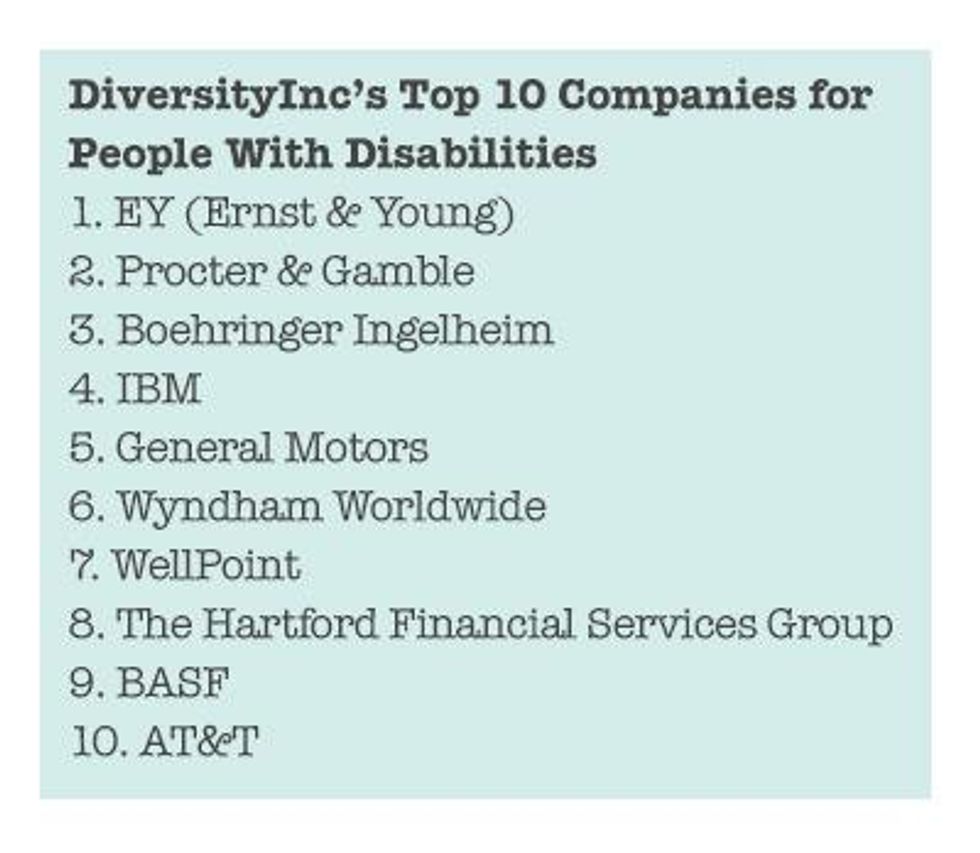 Each year DiversityInc ranks the Top 10 Companies for People With Disabilities (see its 2014 list at left) and while that doesn’t say anything specific about poz workers, it does point out some great companies generally, and it uses measurements that could help you determine if a company would be a good fit for you. For example, DiversityInc researchers consider whether certain benefits are available and utilized, including telecommuting and alternative career tracks for those with long-term family-care issues; whether a company tracks the number of people with disabilities in the workforce; and the role employee resource groups for people with disabilities plays in creating an inclusive workplace. Yes, for some companies, “workers with disabilities” is often simply translated as “workers in wheelchairs,” but savvy organizations know that’s not the totality of a diverse workforce.
Another tell of whether your company supports poz workers: Whether its CEO joined in a call to end HIV travel restrictions, calling them “bad for business.” More than 20 CEOs signed an unprecedented pledge urging the repeal of laws and policies in 46 countries that still deport, detain, or deny entry to people solely because they are living with HIV. They represented companies including Johnson & Johnson, Coca-Cola, Pfizer, Heineken, Merck, Gilead, Virgin, Kenneth Cole, OraSure, Aetna, and the NBA.
“HIV travel restrictions are discriminatory and bad for business,” said Chip Bergh, president and CEO of Levi Strauss and Co., who launched the CEO petition along with the Joint United Nations Programme on HIV/AIDS and GBCHealth, a coalition of companies that address global health challenges. “Global business leaders are coming together to make sure we end these unreasonable restrictions.”
Bergh and others argued that HIV travel restrictions are a hindrance in today’s globalized economy because companies must be able to send their employees and best talent overseas, regardless of their HIV status. “Travel restrictions on individuals with HIV are unnecessary and hinder the ability for individuals and companies to operate in a truly global workforce,” said Mark Bertolini, chairman, CEO, and president of Aetna.
Of course, none of this helped Andrew at his old company, nor Noah Crawford, who said he wasn’t hired by Popeye’s Chicken & Biscuits in Longview, Texas, despite his many qualifications, because he was poz. Then again, Crawford got $25,000 from that company in a settlement of his lawsuit, and a taxi driver in Florida is getting a fat check from the biggest taxi company that serves Disney World (details of the settlement weren’t disclosed). So as smart companies court people with HIV and stupid ones get fined for discrimination, perhaps we can build a world where HIV-positive workers aren’t just tolerated but celebrated for their unique contributions to the workplace.
*Not his real name.

From our Sponsors
Most Popular
Latest Stories